

GUILD OF IMPLANTOLOGIST MENTORS PRACTITIONERS & CLINICAL OUTCOME
FROM THE HOUSE OF OYSTER DENTAL CARE

ADVANCING IMPLANT DENTISTRY TOGETHER

GALLERY
 Congratulations to Dr. Subhadeep on Achieving the Prestigious FICOI Fellowship at ICOI Chennai 2026We are proud to congratulate Dr. Subhadeep Mukherjee on achieving the prestigious Fellowship of the International Congress of Oral Implantologists (FICOI)—one of the most respected international credentials in dental implantology and oral implantology. This remarkable achievement recognizes his dedication to advanced dental implant treatment, clinical excellence, and commitment to continuous professional education. The FICOI credential is awarded to clinicians who demonstrate exceptional knowle |  Congratulations to Dr. Shakir on Achieving the Prestigious FICOI Fellowship at ICOI Chennai 2026We are delighted to congratulate Dr. Shakir Ahamed on achieving the prestigious Fellowship of the International Congress of Oral Implantologists (FICOI)—one of the world's most respected credentials in dental implantology and oral implantology. This remarkable accomplishment reflects his unwavering dedication to clinical excellence, continuous professional development, and the pursuit of advanced knowledge in implant dentistry. The FICOI credential is awarded to clinicians who have demonstrated |  Congratulations to Dr. Jay on Achieving the Prestigious FICOI Fellowship at ICOI Chennai 2026We are delighted to congratulate Dr. Jay Prakash on achieving the prestigious Fellowship of the International Congress of Oral Implantologists (FICOI)—one of the world's most respected credentials in dental implantology and oral implantology. This outstanding achievement reflects his dedication to clinical excellence, commitment to lifelong learning, and passion for advancing the field of implant dentistry. The FICOI credential is awarded to clinicians who demonstrate exceptional knowledge, cli |  Congratulations to Dr. Vishal on Achieving the Prestigious FICOI Fellowship at ICOI Chennai 2026We are delighted to extend our heartfelt congratulations to Dr. Vishal Bhola on achieving the prestigious Fellowship of the International Congress of Oral Implantologists (FICOI)—one of the most respected international credentials in dental implantology and oral implantology. This distinguished achievement reflects Dr. Bhola's unwavering dedication to clinical excellence, advanced education, and the continuous pursuit of innovation in implant dentistry. The FICOI credential is awarded to clinic |
|---|
CASE :1
A CASE OF: upper anterior rehabilitation
This case involved the rehabilitation of a missing maxillary central incisor following successful soft tissue healing after tooth extraction. Clinical evaluation revealed favorable gingival maturation approximately 60 days post-extraction, creating an ideal foundation for implant therapy. A prosthetically driven implant placement protocol was followed to ensure precise three-dimensional implant positioning and long-term esthetic success. After adequate osseointegration, a custom implant-supported crown was delivered, restoring the patient's smile with excellent soft tissue harmony, natural emergence profile, and functional occlusion. The final outcome demonstrates predictable implant rehabilitation with healthy peri-implant tissues, optimal esthetics, and patient satisfaction. At Oyster Dental Care & Implant Studio, we combine evidence-based implant dentistry, digital treatment planning, and meticulous surgical protocols to provide long-lasting, natural-looking dental implant solutions.
 |  |  |
|---|---|---|
 |  |  |
 |
CASE :2
A CASE OF: immediate implant in a fractured tooth with autograft harvest
 |  |  |  |
|---|---|---|---|
 | 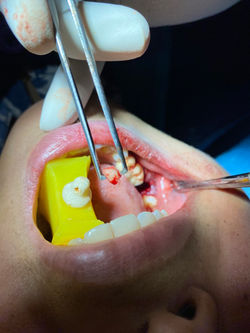 |  |  |
Case Summary The patient presented with pain in the lower posterior region. Clinical and radiographic examination revealed a vertical root fracture of the mandibular second molar, making the tooth non-restorable. An atraumatic extraction was performed, followed by immediate dental implant placement to preserve the surrounding bone and reduce overall treatment time. Autogenous bone harvested from the surgical site was combined with hydroxyapatite bone graft to prepare sticky bone, which was placed around the implant to support bone regeneration and long-term implant stability. Healing progressed uneventfully, with healthy soft tissue observed during follow-up. After 60 days, the final implant-supported crown was delivered, restoring normal chewing function, esthetics, and the patient's smile. This case highlights the success of immediate dental implant treatment, bone grafting, and implant-supported tooth replacement, providing a predictable and long-lasting solution for a fractured molar.
CASE :3
A CASE OF: delayed implant with flaples approach
A patient presented with a grossly decayed mandibular molar causing pain and functional discomfort. Clinical and radiographic evaluation revealed that the tooth had a hopeless prognosis, making extraction the most appropriate treatment option. Following atraumatic tooth extraction, the site was allowed to heal to ensure optimal bone and soft tissue maturation. After the healing phase, a delayed dental implant was planned and placed using a minimally invasive tissue punch technique, eliminating the need for a conventional surgical flap. This approach helped preserve the surrounding soft tissues, reduced post-operative discomfort, and promoted faster healing. The implant achieved excellent primary stability and was allowed to osseointegrate successfully. After the healing period, a custom prosthetic crown was delivered, restoring the patient's chewing efficiency, aesthetics, and long-term oral function. At Oyster Dental Care & Implant Studio, Siliguri, every implant case is digitally planned to ensure precise implant positioning, predictable outcomes, and long-term success.
 |  |  |  |
|---|---|---|---|
 |  |  |  |
CASE :4
A CASE OF: lateral incisor and canine implant placement
 |  |  |  |
|---|---|---|---|
 |  |  |  |
A patient presented with a missing maxillary lateral incisor and canine, resulting in compromised smile aesthetics, reduced confidence, and impaired chewing function. Following a comprehensive clinical examination and digital radiographic evaluation, a treatment plan was developed to restore the missing teeth with two dental implants, providing a fixed, long-lasting solution while preserving the adjacent natural teeth. The implant surgery was performed with precise digital planning to achieve ideal implant positioning and optimal prosthetic outcomes. After successful osseointegration, custom implant-supported crowns were fabricated to closely match the patient's natural teeth in shape, shade, and contour. The final restoration provided excellent aesthetics, restored proper function, and helped maintain the surrounding bone and soft tissue architecture. Dental implants remain the gold standard for replacing missing teeth, offering superior stability, durability, and a natural appearance compared to removable dentures or conventional bridges. This case successfully restored both the patient's smile and confidence with a predictable, minimally invasive implant solution.
A patient presented with a failed full-mouth dental implant rehabilitation performed elsewhere, resulting in implant failure, prosthetic instability, difficulty in chewing, compromised aesthetics, and significant loss of confidence. Clinical examination and CBCT evaluation revealed multiple failing implants, inadequate prosthetic planning, and compromised hard and soft tissue conditions. A comprehensive treatment plan was developed to restore function, aesthetics, and long-term predictability. The failed implants and prosthetic components were carefully removed, followed by meticulous site evaluation and healing. Using a prosthetically driven digital workflow, the case was redesigned from the foundation up. Based on the available bone volume and anatomical considerations, the patient was rehabilitated with the All-on-4® dental implant concept, strategically placing four implants to maximize existing bone while avoiding extensive grafting procedures. Advanced digital planning ensured ideal implant positioning, angulation, and emergence profile, allowing for optimal load distribution and long-term prosthetic success. Following successful osseointegration, a custom full-arch implant-supported prosthesis was fabricated, restoring the patient's smile, facial support, speech, chewing efficiency, and overall quality of life. The final outcome transformed a previously failed implant case into a stable, functional, and aesthetically pleasing full-mouth rehabilitation. The patient regained the confidence to smile, eat comfortably, and enjoy the benefits of a fixed implant-supported dentition. At Oyster Dental Care & Implant Studio, Siliguri, complex implant failures and revision cases are managed using advanced digital diagnostics, evidence-based treatment planning, and modern implant protocols to deliver predictable, long-lasting results.
 |  |  |  |
|---|---|---|---|
 |  |  |  |
 |  |  |  |
CASE :5
A CASE OF: rehabilitation of upper arch all on four dental implant
 |  |  |  |
|---|---|---|---|
 |
CASE :6
A CASE OF: rehabilitation of upper left quadrent and lower full arch
A 78-year-old male patient presented with a severely compromised dentition characterized by multiple missing teeth, failing restorations, retained roots, and extensive periodontal deterioration. The patient experienced significant difficulty in chewing, poor aesthetics, and reduced oral function, greatly affecting his quality of life. After a comprehensive clinical examination and CBCT-guided digital treatment planning, the decision was made to rehabilitate both arches with a full-mouth implant-supported fixed prosthesis. The treatment objective was to restore optimal function, aesthetics, phonetics, facial support, and long-term stability using strategically placed dental implants.